The Dopamine Trap: Why Nothing Feels Exciting Anymore
By Dr Naazneen

“Food tastes fine. Work is okay. Weekends don’t feel special anymore. Even the things I used to enjoy don’t excite me like they used to.”
This is something I hear surprisingly often in my clinic.
Many people assume they’ve become lazy, unmotivated, or that something is “wrong” with them.
But sometimes, the issue isn’t a lack of happiness.
It’s a brain that has become accustomed to constant stimulation.
As a psychiatrist, I believe one of the biggest challenges of modern life isn’t just stress or anxiety—it’s the way we’ve trained our brains to expect instant rewards.
This is what I call the dopamine trap.
First, Let’s Clear Up a Common Myth
You’ll often hear people say,
“Dopamine is the happiness hormone.”
That’s not entirely true.
Dopamine doesn’t create happiness.
It creates motivation, anticipation, and the desire to seek rewards.
Imagine receiving a notification on your phone.
Before you even know what it says, your brain becomes curious.
That feeling of “Let me check quickly” is dopamine at work.
It’s pushing you to seek the reward—not guaranteeing you’ll enjoy it.
Why Modern Life Is Full of Dopamine Traps
Years ago, rewards came naturally.
You worked hard.
You achieved something.
You celebrated.
Today, rewards arrive every few seconds.
A new reel.
A new like.
A new message.
A flash sale.
A viral video.
Your brain is constantly being told,
“Here’s something new.”
Without realizing it, we begin to crave novelty rather than satisfaction.
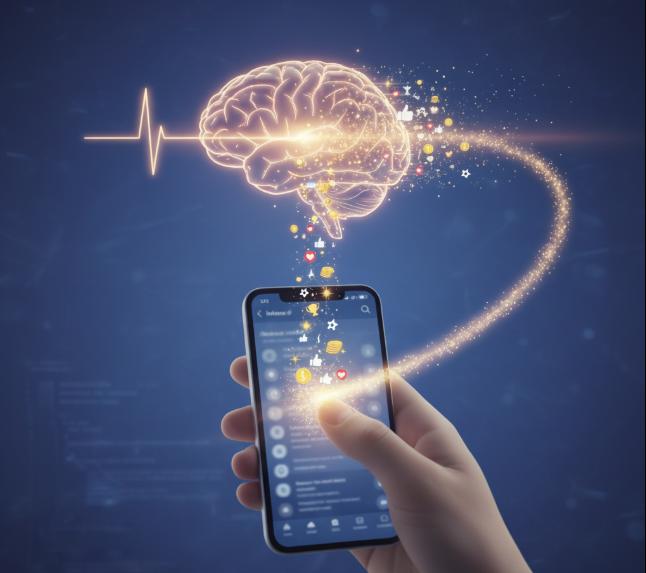
The Problem Isn’t Dopamine—It’s Constant Overstimulation
Dopamine itself isn’t bad.
In fact, it’s essential for learning, motivation, and goal-directed behaviour.
The challenge begins when the brain rarely gets a break from stimulation.
When every spare moment is filled with scrolling, notifications, or rapid entertainment, ordinary experiences can start to feel less engaging by comparison.
This doesn’t mean your brain is “broken.” It means it may be adapting to a high-stimulation environment.
Signs You May Be Caught in the Dopamine Trap
You don’t have to spend all day on your phone.
Sometimes, the signs are more subtle.
You might notice that:
- You pick up your phone without thinking.
- You struggle to watch a full movie without checking notifications.
- Reading a book feels difficult.
- You become bored very quickly.
- Completing everyday tasks feels unrewarding.
- You constantly search for “something more.”
If these experiences sound familiar, it may be worth reflecting on your digital habits—not judging yourself for them.
Why Everyday Life Starts Feeling Less Exciting
Think about eating your favourite dessert.
If you have it once a month, it feels special.
If you eat it five times a day, the excitement naturally fades.
Our brains work in a similar way.
When we’re constantly exposed to highly stimulating content, quieter moments—reading, walking, talking with loved ones, or simply resting—may feel less engaging.
This isn’t because those activities have lost their value.
It’s because your brain has become accustomed to higher levels of stimulation.
Social Media Isn’t the Villain
It’s important to avoid blaming technology.
Social media helps people learn, connect, build communities, and express themselves.
The issue isn’t social media itself.
The issue is when it begins to replace every moment of boredom, silence, or reflection.
Those “empty” moments are often when creativity, problem-solving, and emotional processing happen.
How to Break Free From the Dopamine Trap
You don’t need to delete every app or disappear from the internet.
Small changes often make the biggest difference.
1. Reintroduce Boredom
Instead of reaching for your phone while waiting in a queue, simply observe your surroundings.
Boredom isn’t wasted time.
It’s recovery time for your brain.
2. Delay Instant Rewards
If you feel the urge to check your phone, wait five minutes.
This simple pause helps you respond intentionally instead of automatically.
3. Choose One Thing at a Time
Watch one video.
Read one article.
Finish one task.
Multitasking often creates more mental clutter than productivity.
4. Build Rewards That Last
Try activities that create a sense of accomplishment rather than quick stimulation:
- Exercise
- Reading
- Learning a language
- Gardening
- Playing an instrument
- Spending uninterrupted time with loved ones
These may not provide instant excitement, but they often leave a deeper sense of satisfaction.
5. Protect Your Morning and Night
Avoid making your phone the first and last thing you interact with every day.
Giving your brain a calm start and finish can make a noticeable difference over time.
A Psychiatrist’s Perspective
If life has started feeling dull, it doesn’t automatically mean you’re depressed.
If you enjoy scrolling more than real life, it doesn’t automatically mean you’re addicted.
Sometimes, your brain is simply responding to an environment filled with constant novelty.
That doesn’t mean you need to fear technology.
It means your brain deserves balance.
If these feelings persist, interfere with your daily life, or are accompanied by ongoing sadness, hopelessness, or loss of interest in almost all activities, it’s important to seek a professional mental health evaluation. A psychiatrist or psychologist can help determine whether something more than digital overstimulation is contributing to how you feel.
Final Thoughts
We live in a world that constantly competes for our attention.
Every app, notification, and recommendation is designed to keep us engaged.
But a meaningful life isn’t built on endless stimulation.
It’s built on presence.
The ability to enjoy a quiet conversation.
A slow walk.
A good book.
A hobby.
A meal shared with family.
These moments may not produce the same instant excitement as a viral reel.
But they’re often the ones that stay with us the longest.
Perhaps the goal isn’t to chase more dopamine.
Perhaps it’s to rediscover the joy of enough.