Your Brain Is Lying to You, Here’s How to Fight Back
By Dr Naazneen

In fifteen years of clinical practice, the single most surprising thing I’ve learned isn’t about rare disorders or extreme trauma, it’s that the ordinary, everyday human brain is a spectacular, compulsive, relentless liar. And most of us have absolutely no idea.
Every morning you wake up, your brain hands you a version of reality. You assume it’s accurate. You make decisions, form judgments, feel emotions — all based on this feed. But neuroscience has spent decades documenting something uncomfortable: that feed is heavily filtered, subtly distorted, and occasionally just plain wrong.
This isn’t a character flaw. It’s biology. And understanding it is one of the most powerful things you can do for your mental health.
The Lying Brain: What Psychiatry Actually Sees
When a patient comes to my clinic convinced their life is falling apart — or that their friend hates them, or that they will never get better — I rarely hear delusions. I hear cognitive distortions. These are systematic errors in thinking that feel completely, undeniably true to the person experiencing them.
The concept was introduced by psychiatrist Aaron Beck in the 1960s and it changed everything. The idea is simple: your thoughts are not facts. They are interpretations. And your brain has a favourite set of distortions it keeps returning to.

8 Ways Your Brain Is Tricking You Right Now
1. Catastrophising One bad meeting = your career is over. One argument = the relationship is ruined. Your brain automatically jumps to the worst possible outcome as a survival mechanism. Most of the time, the disaster never comes.
2. Mind Reading You become convinced you know what others are thinking — and it’s always negative. “She didn’t reply quickly, she must be angry with me.” Spoiler: you’re almost always wrong.
3. All-or-Nothing Thinking If it isn’t perfect, it’s a total failure. No middle ground. This black-and-white thinking is one of the biggest drivers of perfectionism and burnout.
4. Emotional Reasoning “I feel like a failure, so I must be one.” Your brain treats feelings as hard evidence. This is one of the most common and most damaging distortions I see in my clinic.
5. Personalisation Taking blame for things that are not your fault. “The project failed — it must be because of me.” Your brain loves casting you as the villain in other people’s stories.
6. Overgeneralisation One rejection becomes “I always get rejected.” One mistake becomes “I always mess up.” The word always is almost always a warning sign.
7. Mental Filtering You get 10 compliments and 1 piece of criticism — and your brain zooms in on the criticism and ignores everything else. Negativity bias is deeply wired into us.
8. The “Should” Trap “I should be further ahead.” “I should feel happy by now.” These self-imposed rules create constant guilt and shame — with no real benefit to anyone, including you.
Why Does Your Brain Do This? The Simple Explanation
Your brain evolved over hundreds of thousands of years with one main job: keep you alive. Not happy. Not rational. Alive.
The part of your brain that detects threats — called the amygdala — cannot always tell the difference between a wild animal and a harsh email from your boss. It reacts the same way to both.
The rational, thinking part of your brain — the prefrontal cortex — can calm this reaction down. But here’s the problem: it’s slower, uses more energy, and is the first thing to stop working properly when you’re stressed or tired. The more pressure you’re under, the more your distorted, fear-based thinking takes over.
Social Media Is Making It Worse
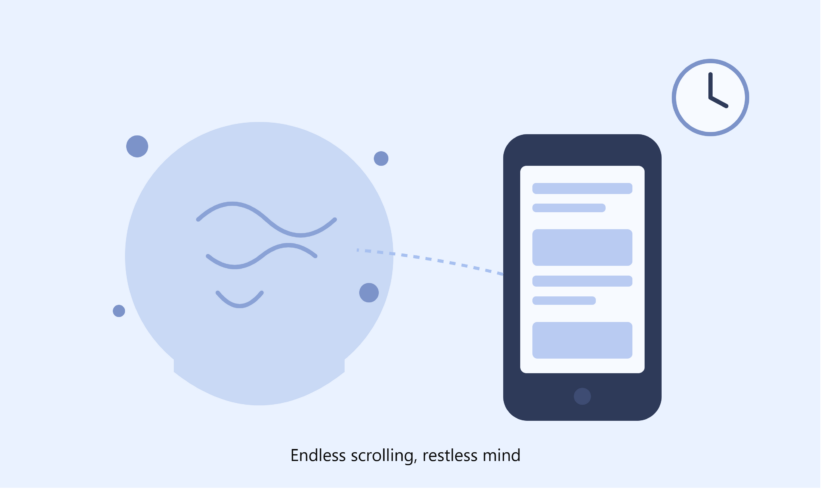
This is something I’m seeing more and more in clinical practice. Social media platforms are designed — deliberately — to trigger your brain’s threat-detection system. Fear, outrage, comparison, and envy drive the most engagement. So the algorithm serves you more of it.
When you scroll through your phone at night, you’re not relaxing. You’re running your most anxious brain on a treadmill. The result is heightened anxiety, distorted self-image, and a brain that becomes more reactive and less rational over time.
Patients who cut their social media use by just 30 minutes a day report better sleep, less rumination, and calmer moods — within two to three weeks. It’s one of the simplest prescriptions I write.
5 Things You Can Do Starting Today
1. Name the distortion. When a distressing thought appears, ask yourself: “Which distortion is this?” Just identifying it creates distance between you and the thought — and weakens its power over you.
2. Test it like a scientist. Ask: “What’s the actual evidence for this thought? What contradicts it?” Your brain skips this step automatically. You have to do it on purpose.
3. Give yourself a worry window. Set aside 15 minutes a day for worrying — and when anxious thoughts pop up outside of that time, write them down and save them for later. This sounds too simple to work. It isn’t.
4. Talk to yourself like a friend. Ask: “What would I tell my best friend if they had this thought?” You are almost always kinder, more balanced, and more rational with others than with yourself. Use that.
5. Protect your sleep. A tired brain cannot regulate anxiety. Every single distortion on this list gets worse on poor sleep. Good sleep is not optional self-care — it is the foundation of every other mental health strategy.
When Is It Time to See Someone?
These thinking patterns affect everyone. For most people, awareness and small daily habits make a big difference.
But please reach out to a professional if:
- These thoughts are present most of the day, most days
- Your relationships or work are being significantly affected
- You’re sleeping badly, losing your appetite, or feeling physically exhausted
- You’re using alcohol, substances, or other behaviours just to quiet the noise
Therapy — especially Cognitive Behavioural Therapy (CBT) — works. Medication works. Asking for help is not weakness. It is, in fact, the most rational decision your brain can make.
A Final Word from the Clinic
The human mind is the most extraordinary thing in the known universe. It builds cities, writes music, loves deeply, and solves impossible problems.
It also catastrophises, distorts, and lies to itself on a daily basis.
The goal is not a perfect brain. The goal is a slightly better relationship with the imperfect one you already have. Start there. Everything else follows.