Why Am I Always Overthinking? A Psychiatrist Explains the Real Reasons & Solutions
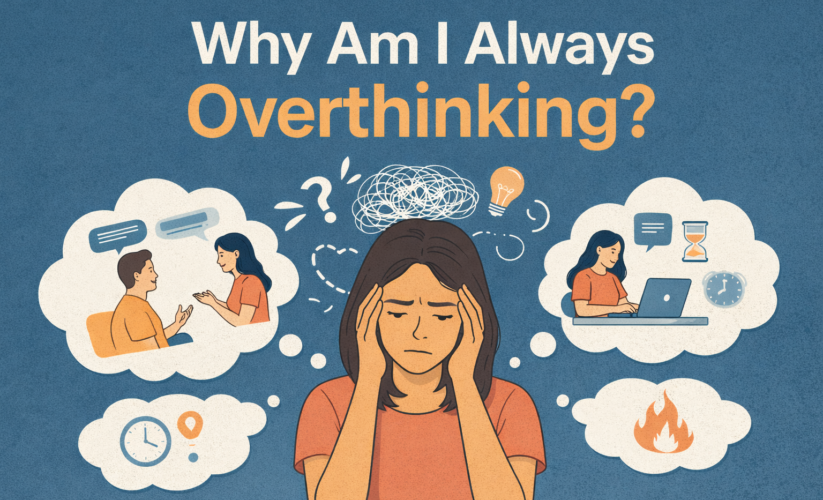
Do you find yourself constantly replaying conversations, overthinking, worrying about the future, or analysing situations over and over again — even when nothing is actually wrong?
If yes, you’re not alone.
Overthinking is one of the most common mental health complaints seen by psychiatrists today. While occasional overthinking is normal, chronic overthinking can drain your energy, affect sleep, increase anxiety, and reduce quality of life.
Let’s understand why overthinking happens, what it means, and how you can stop it — from a psychiatrist’s perspective.
- ase scenarios
- Excessive self-doubt
- Difficulty “switching off” the mind
- Mental fatigue
Overthinking is not a personality flaw — it’s a psychological response to stress, anxiety, or emotional overload.
Why Am I Always Overthinking? (Common Psychiatric Reasons)
1. Anxiety Disorders
The most common cause of overthinking is anxiety.
An anxious brain constantly scans for danger — even when there is none.
You may overthink because:
- Your mind is stuck in “alert mode”
- You fear making mistakes
- You want control over uncertain situations
2. Past Emotional Trauma
Unresolved emotional experiences can train the brain to anticipate threat.
If you’ve experienced:
- Emotional hurt
- Rejection
- Failure
- Loss
Your mind may overthink as a self-protection mechanism.
3. Perfectionism & Fear of Judgment
People who are highly self-critical often overthink because they:
- Want everything to be perfect
- Fear being judged
- Struggle with self-acceptance
This creates a mental loop of “Did I say the right thing?” or “What if I fail?”
4. Overstimulation & Digital Overload
Excessive screen time, social media, and constant notifications keep the brain overstimulated, making it harder to relax.
A tired brain thinks more but understands less.
5. Depression
Overthinking isn’t always anxiety — it can also be depression.
Depressive overthinking includes:
- Rumination about past mistakes
- Guilt and self-blame
- Negative self-talk
6. Lack of Emotional Expression
When emotions aren’t expressed, the mind processes them internally — through overthinking.
Talking helps. Silence feeds overthinking.
Signs Overthinking Is Affecting Your Mental Health
You should pay attention if overthinking:
- Disturbs your sleep
- Causes physical fatigue or headaches
- Makes decision-making difficult
- Triggers anxiety or panic
- Affects work or relationships
- Leads to irritability or mood swings
These are signs your mind needs professional support, not just willpower.
How to Stop Overthinking – Psychiatrist-Recommended Strategies
1. Label the Thought
Instead of engaging with every thought, say:
“This is an overthinking thought, not a fact.”
This creates mental distance.
2. Set ‘Thinking Time’
Give your brain 15 minutes daily to think freely — and stop outside that time.
This trains your mind to contain worry.
3. Practice Grounding Techniques
Simple grounding exercises:
- Deep breathing
- Sensory awareness (5 things you see, 4 you feel, etc.)
- Mindfulness
They bring your brain back to the present moment.
4. Reduce Digital Noise
Limit:
- Social media scrolling
- News consumption
- Late-night screen time
Mental calm begins with digital boundaries.
5. Try Cognitive Behavioral Therapy (CBT)
CBT is one of the most effective treatments for chronic overthinking.
It helps you:
- Identify thought distortions
- Challenge negative thinking
- Build emotional control
6. Medication (If Needed)
If overthinking is linked to anxiety or depression, psychiatric medication can help regulate brain chemistry — safely and effectively.
When Should You See a Psychiatrist for Overthinking?
You should seek professional help if:
- Overthinking lasts for weeks or months
- Self-help methods don’t work
- Anxiety or sadness increases
- Sleep or appetite is affected
- You feel mentally exhausted
Early treatment prevents long-term emotional burnout.
Final Thoughts: Your Mind Is Not Your Enemy
Overthinking doesn’t mean you’re weak or broken.
It means your mind is overworked and overwhelmed.
With the right guidance, therapy, and support, you can train your mind to feel calmer, clearer, and more in control.
If you’re struggling with constant overthinking, Dr. Naazneen Ladak, an experienced psychiatrist in Andheri, Mumbai, offers compassionate, evidence-based care to help you regain mental peace.